

Werner Herzog has never chased ordinary stories. The legendary German filmmaker, 83, now turns his lens toward one of the strangest wildlife quests in modern exploration. His new documentary, “Ghost Elephants,” follows a stubborn search for a herd of elephants that may carry the bloodline of the largest elephant ever recorded.
The film drops viewers into Angola’s remote highlands, where mist drifts through dense forest and elephant tracks appear and vanish like rumors. Herzog directs, narrates, and writes the documentary, shaping the journey into something bigger than a wildlife expedition.
The WorthWhile Quest
Henry measured more than thirteen feet tall, a staggering size that still shocks visitors decades later.
Steve Boyes, a conservation biologist and National Geographic Explorer, believes Henry’s descendants may still roam the forests of Angola. His goal sounds simple, but feels nearly impossible. He hopes to collect DNA from a mysterious population of elephants that locals call the ghost elephants.
Boyes believes these animals may connect directly to Henry’s genetic line. The idea has driven him into some of the least-explored forests in southern Africa. A single DNA sample from dung or tissue could prove that the largest elephant ever recorded left behind a living legacy.
The expedition unfolds in the highlands of southeastern Angola, a region locals call the source of life. The forests here feed rivers that later become the famous Okavango Delta. For decades, very few scientists could even enter the area.
Angola’s brutal civil war locked the region away for 26 years. The conflict devastated wildlife across the country and funded itself partly through the ivory trade. As many as one hundred thousand elephants were slaughtered during that time.
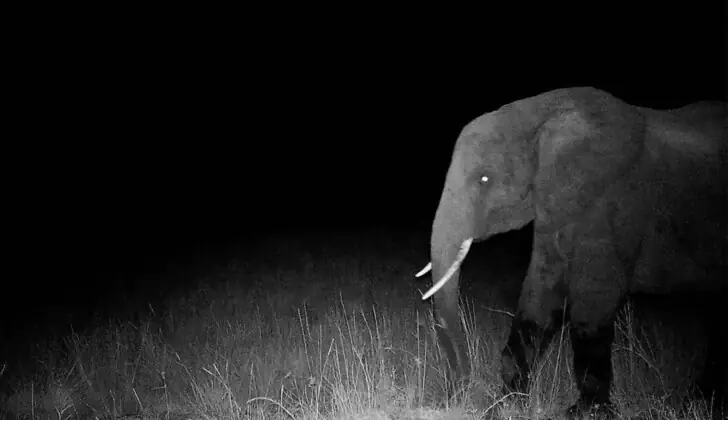
The elephants that survived changed their behavior in response to the violence. These animals move mostly at night and travel in eerie silence despite their enormous size. Researchers believe generations of elephants learned to avoid humans at all costs.
Trackers, Tradition, and Ancient Knowledge

Xui, Xui Dawid, and Kobus move through the forest with quiet confidence. They study broken twigs, shallow footprints, and faint disturbances in the soil. Herzog compares their ability to reading tracks the way people read a newspaper.
The trackers also bring cultural traditions that shape the expedition’s spirit. One ritual, known as the Elephant Dance, plays a symbolic role in reconnecting with the animals. The practice reflects an old belief that humans and elephants share deep spiritual ties.
However, “Ghost Elephants” does not behave like a traditional nature documentary. Herzog treats the expedition as a reflection on human dreams and the stubborn urge to chase mysteries. The film often pauses on quiet landscapes while his narration drifts into deeper questions.
He wonders aloud if some dreams should remain unfinished. The unknown holds a strange beauty that disappears once the answer appears. Herzog frames Boyes as a dreamer who refuses to abandon a question that might never be solved.
The documentary premiered at the Venice Film Festival, where Herzog received the Golden Lion for Lifetime Achievement. Soon after the premiere, National Geographic acquired the film for release.
“Ghost Elephants” aired on National Geographic and later became available for streaming on Disney+ and Hulu. The release arrives alongside Steve Boyes’s book “Okavango and the Source of Life,” which explores the same landscapes and conservation work in greater detail.